Contact Us Careers
Lung Cancer

In the early stage of poorly differentiated lung adenocarcinoma, surgical treatment is not a permanent solution

时间:2026-04-22 人气:

If you cannot understand the subsequent professional description, you can finish reading this text in two minutes

Overview of the disease


In 2010, Mr. Wang discovered a mass in his right lung during a physical examination, but he did not pay much attention and continued to follow up regularly. It was not until July 2014, when he underwent a chest CT scan for a follow-up examination, that lesions were found in the posterior segment of the right upper lobe and the dorsal segment of the right lower lobe, suggesting multicentric invasive adenocarcinoma.
Eight years ago, Mr. Wang's younger brother was diagnosed with lung cancer. Despite undergoing surgery and chemotherapy, he passed away after a year. The malignancy of Mr. Wang's multicentric invasive adenocarcinoma was higher, plunging his entire family into a state of sorrow and despair.
In August 2014, upon being diagnosed with lung cancer, Mr. Wang underwent immediate surgical treatment. Postoperative pathology revealed: invasive adenocarcinoma, predominantly alveolar type, moderately differentiated, with positive vascular invasion and positive pleural infiltration; (right upper lung) invasive adenocarcinoma, predominantly papillary type, poorly differentiated.
Department

Pu    
small
Knowledge

knowledge


Invasive adenocarcinoma with "multicentric origin"

Although the tumors in Mr. Wang's right upper lung and pleura were both adenocarcinoma in postoperative pathology, the two nodules had different properties, suggesting the possibility of dual primary cancer - that is, having two types of cancer simultaneously, which is a very rare condition. The tumor in the pleura was poorly differentiated adenocarcinoma, indicating a potentially poor prognosis. The degree of differentiation in pathological classification reflects the malignancy of the tumor. Canceration of normal cells generally occurs during the transformation from stem cells to normal cells. The lower the degree of differentiation, the closer the tumor cells are to stem cells and the greater the difference from normal cells, with stronger proliferative capacity, mutation ability, self-repair ability, and resistance to chemotherapy and radiotherapy. Conversely, high differentiation indicates that the tumor cells are more similar to normal cells, which means the malignancy of the tumor is relatively low and the possibility of metastasis is relatively small.
However, patients with lung adenocarcinoma have one more treatment option than those with lung squamous cell carcinoma - targeted therapy. After surgery, Mr. Wang did not undergo chemotherapy, but after genetic testing, EGFR mutations were found, and he was treated with gefitinib, a targeted drug, for four months.
Despite undergoing timely surgical treatment and targeted therapy, Mr. Wang still felt uneasy. The pathology report mentioned vascular invasion. Vascular invasion is a high-risk factor. Usually, tumors grow by infiltrating deep into tissues, and the invasion of deep vessels by tumors indicates that cancer cells have entered the vascular network. Tumor cells precisely use this method to leave the primary lesion and metastasize to other sites, so there is a greater risk of recurrence in the future.
After reviewing Mr. Yang's medical records, Professor Zhang Minghui made the following analysis and judgment:

1. The patient underwent radical surgery in the early stage of tumor development, and the postoperative staging was relatively early. Taking targeted drugs for 4 months after surgery had a very positive impact on prognosis, but long-term use of targeted drugs may lead to drug resistance and cannot completely eliminate the risk of recurrence and metastasis.

2. Although the early postoperative staging is good news, the vascular invasion and differentiation type indicated by the pathological results still suggest a high risk of recurrence and metastasis. Even though there are currently no tumors detectable by imaging examination, it cannot be guaranteed that recurrence and metastasis will not occur again.

3. NKT therapy utilizes powerful immune cells to eliminate tumor cells that may remain in the body and are undetectable, and it has basically no side effects, making it very friendly to patients. After completing conventional treatment, NKT cell therapy is used to maintain long-term systemic stability.
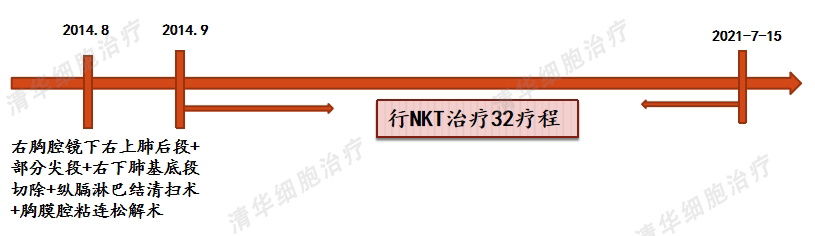
Mr. Wang decided to undergo NKT cell immunotherapy in September 2014. The initial regimen was one course per month, and after multiple follow-up examinations, no signs of recurrence or metastasis were observed. The treatment frequency was reduced to one course every two months. After six consecutive follow-up evaluations showing no signs of recurrence or metastasis, the current regimen has been adjusted to one course every six months.
As of July 2021, a total of 32 courses have been completed, lasting a total of 82 months .


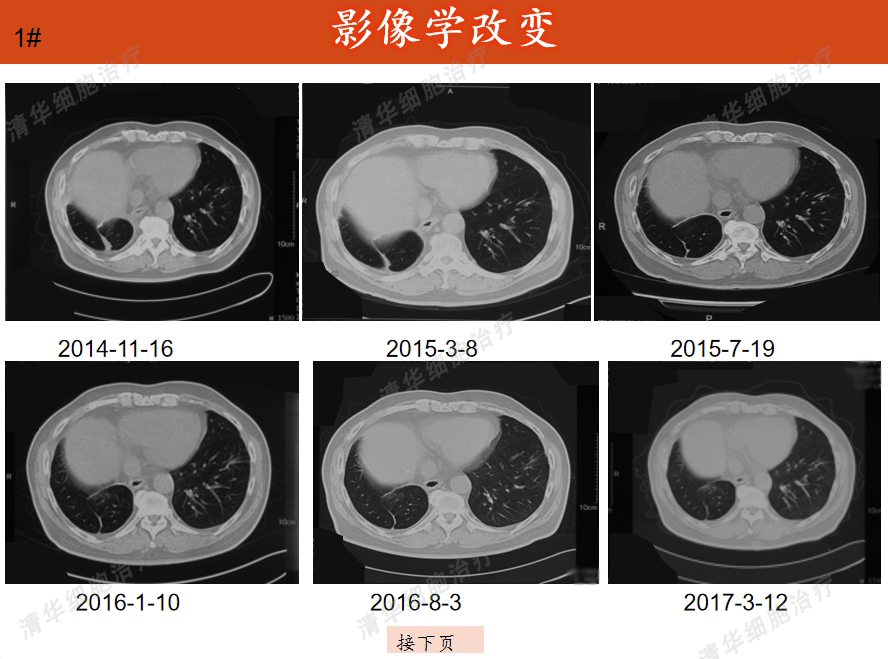
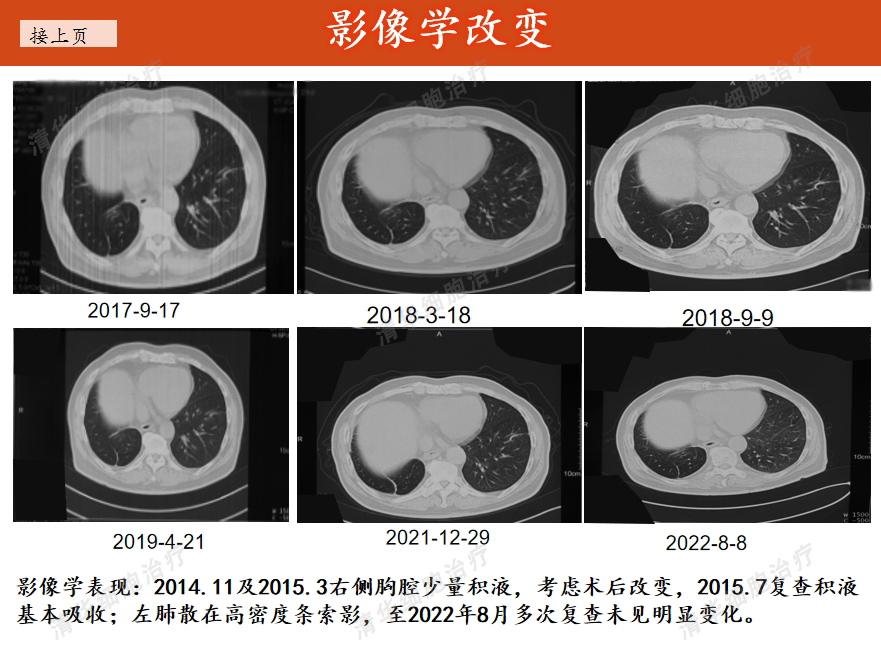
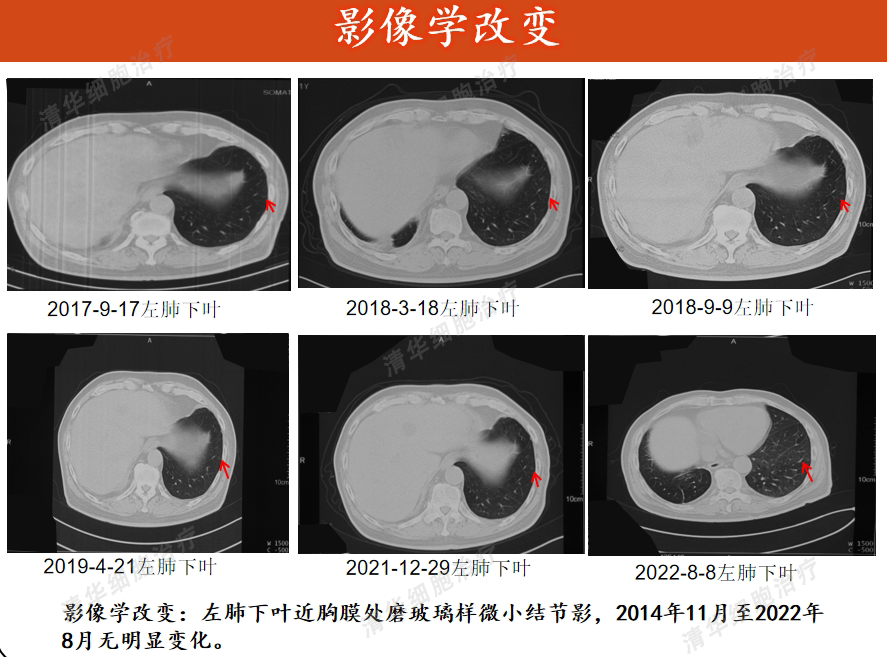
Imaging


 Swelling  < H235>


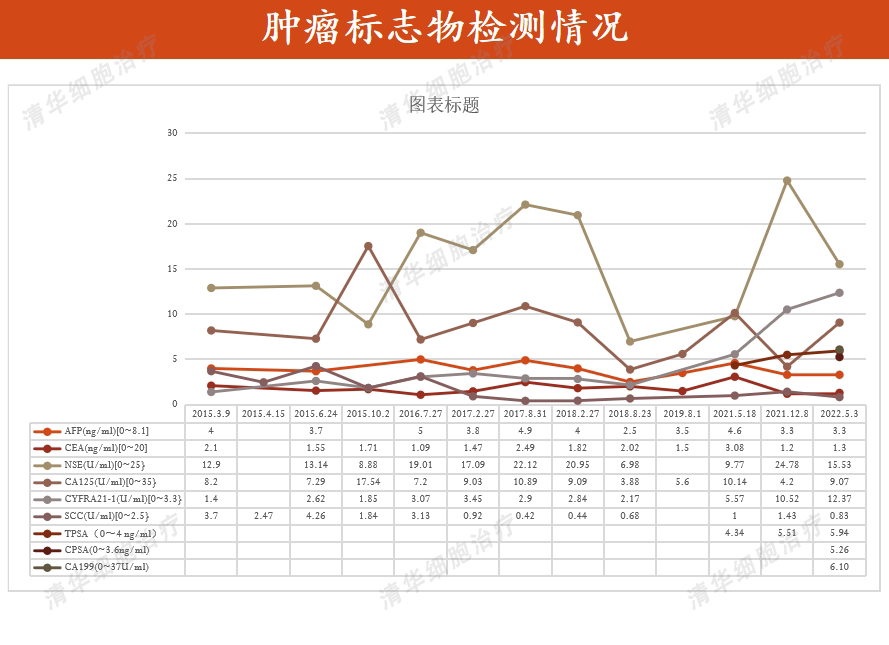
CEA, AFP, NSE, and CA125 were within the normal range from March 2015 to May 2022; CYFRA21-1 showed intermittent elevation from February 27, 2017, to May 3, 2022; SCC showed intermittent elevation from March 2015 to July 2016; NSE was within the normal range from March 2015 to August 2018, but was above normal from December 8, 2021, to May 3, 2022; TPSA was above normal from May 2021 to May 2022; CPSA was slightly above normal on May 3, 2022, and requires follow-up.

 Conclusion and Comments

During the 82 months of continuous changes and adjustments in 32 treatment courses, Mr. Wang's multiple follow-up evaluations showed stable conditions, and his overall mental and physical levels had systematically improved.
Factors such as pathological type, clinical stage, tumor size, lymph node metastasis, surgical method, chemotherapy status, and vascular thrombus all affect the prognosis of patients with non-small cell lung cancer (NSCLC) after surgery. The survival rate of the group with vascular thrombus is significantly lower than that of the group without vascular thrombus (P<0.01); the survival rate of the group with vascular thrombus is significantly lower than that of the group with lymphatic thrombus (P<0.05). The final conclusion is that vascular thrombus is an independent risk factor for the prognosis of NSCLC after surgery, with vascular thrombus being the main risk factor[1].
Mr. Wang's situation is actually quite common. Many patients believe that surgery can provide a permanent solution, ignoring the higher risk of recurrence due to poor pathological type and vascular invasion. NKT cell immunotherapy plays an indispensable role in reducing the risk of recurrence and metastasis. It not only eliminates residual tumor cells but also strengthens the immune system.
References:
[1] Guo Genjun, Liu Shangguo, Zhang Junjie, Zhang Xiajie Correlation analysis of vascular cancer embolus in non-small cell lung cancer and its impact on postoperative prognosis [J]. Modern Cancer Medicine, 2021, 29(13): 2265-2268.
Popular science knowledge for reference only. For individual patients, clinical treatment should prevail.    
Review of NKT classic cases

Click on the image

to view