Contact Us Careers
Hepatobiliary and Pancreatic Cancers

The patient had two recurrences one year after liver cancer surgery, but has now been stable for over seven years

时间:2026-04-22 人气:

If you cannot understand the subsequent professional description, you can finish reading this text in two minutes

Overview of the condition


On January 19, 2015, Mr. Yan experienced discomfort in his upper abdomen for 2 days. Abdominal CT scan revealed a low-density mass lesion in the lower segment of the right lobe of the liver, measuring approximately 6.1cm*6.2cm*6.9cm. After enhancement, rapid wash-in and wash-out were observed, suggesting tumor lesions.
He then sought medical attention at Southwest Hospital of Third Military Medical University and underwent "laparoscopic resection of the right posterior liver segment (including parts of segments Ⅴ, Ⅵ, Ⅶ, and Ⅷ) + cholecystectomy" on January 26, 2015. Postoperative pathology indicated poorly differentiated hepatocellular carcinoma of the right liver.
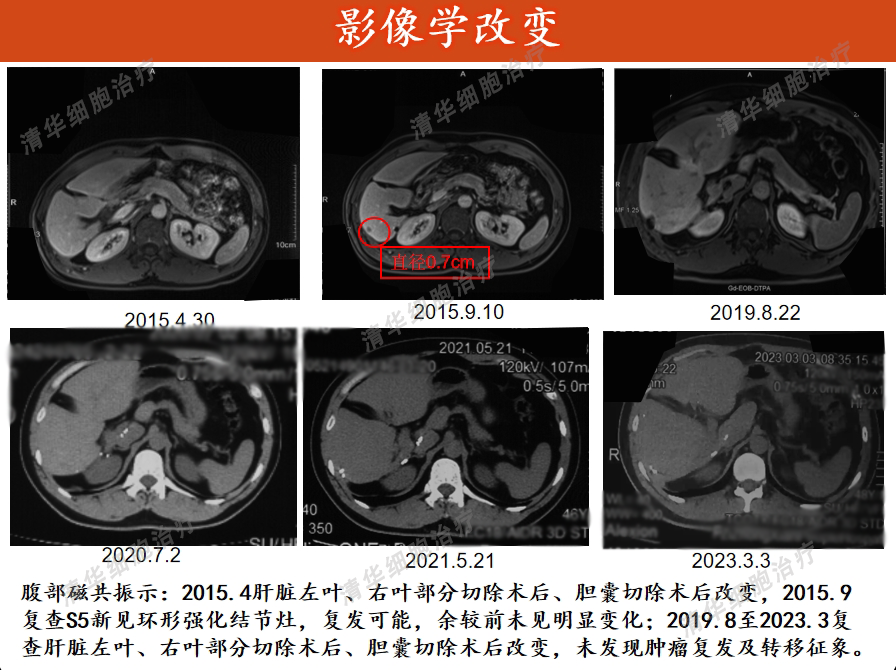
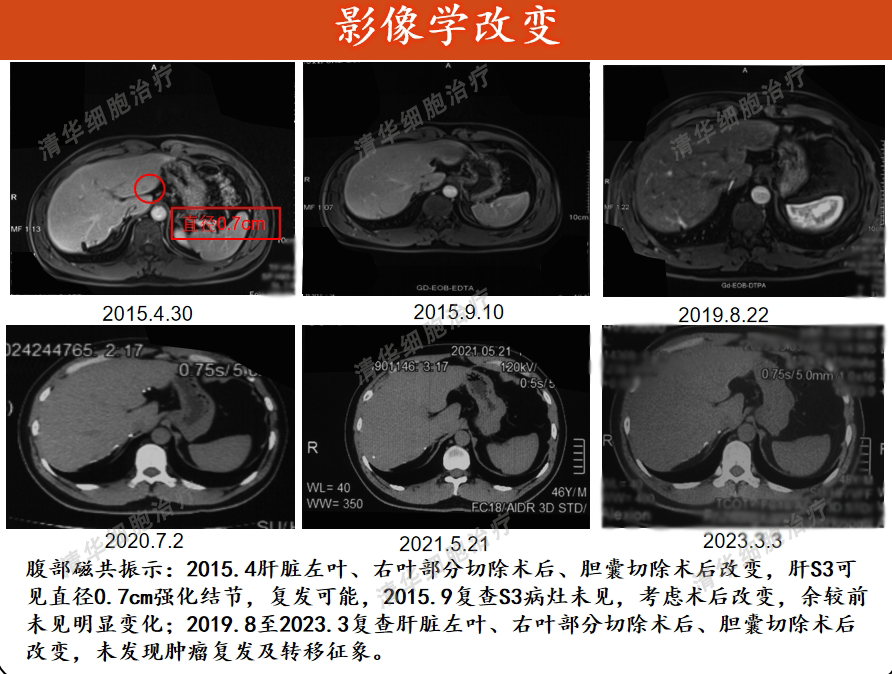
On April 28, 2015, a follow-up MRI of the upper abdomen revealed postoperative changes in the right liver, with a small nodule (0.7cm) in segment Ⅲ of the liver, suggesting recurrence of liver cancer. AFP levels were elevated to 211.5ng/ml. On May 7, 2015, he underwent "laparoscopic resection of left liver cancer," and postoperative pathology indicated moderately differentiated hepatocellular carcinoma of the left liver.
On September 7, 2015, MRI revealed a small nodule in segment Ⅴ of the liver after liver cancer surgery, with EBO-MRI indicating recurrence of liver cancer. AFP levels were elevated to 155.3ng/ml. On September 18, 2015, he underwent "laparoscopic resection of recurrent liver cancer in the right liver," and postoperative pathology indicated moderately differentiated hepatocellular carcinoma of the liver.
Since November 2015, he has been receiving NKT cell immunotherapy, and has completed 35 courses (as of March 2023).
Section
Pu    
small
Knowledge
   

Recognition

Hepatocellular carcinoma

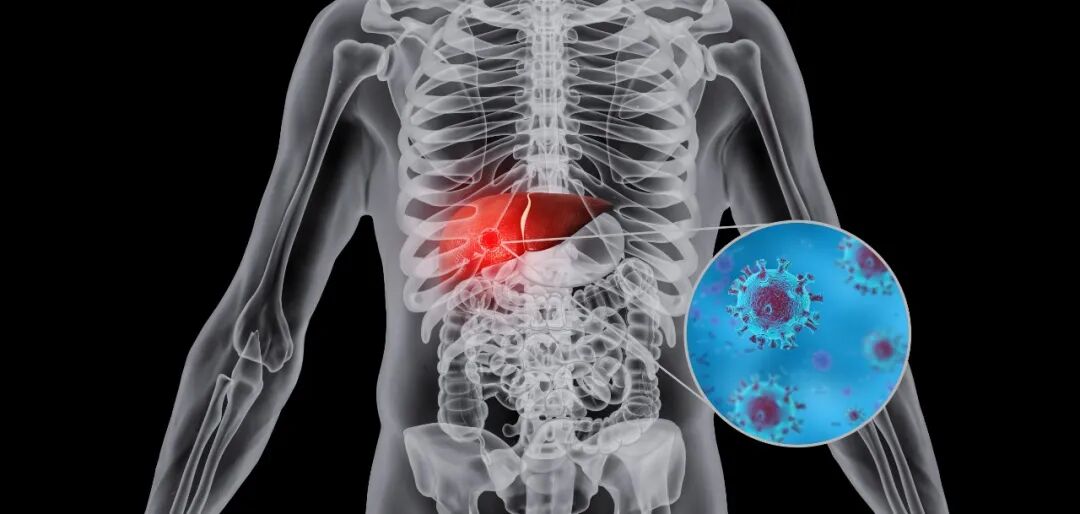
Liver cancer is the sixth most common cancer globally, with 841,080 new cases reported in 2018, making it the fourth leading cause of cancer-related deaths worldwide. Hepatocellular carcinoma is the most common pathological type of liver cancer. The typical CT manifestation is that after injection of contrast medium, the concentration of contrast medium in liver cancer tissue is significantly higher than that in normal liver tissue within a very short period of time, known as "fast-in and fast-out".

The main reason for the unsatisfactory therapeutic effect of liver cancer is late diagnosis. Clinical practice has shown that there is a "world of difference" in the therapeutic effect between small liver cancer (less than 3 cm in diameter) and advanced liver cancer. Advanced liver cancer often accompanies intrahepatic and extrahepatic metastasis, making surgery impossible and "liver transplantation" a contraindication. Pharmacotherapy also rarely yields significant results. Even for cases that are operable, patients have to bear the risks of "high mortality rate" and "high incidence of complications".
Mr. Yan, who had undergone three surgeries, was still worried about recurrence and sought the help of Professor Zhang Minghui's NKT treatment team at Tsinghua University School of Medicine. After carefully reviewing the cases presented by NKT cell therapy, he particularly hoped to try it to reduce the chance of recurrence.  
After reviewing Mr. Yan's medical records, Professor Zhang Minghui made the following analysis and judgment:

1. The patient has undergone multiple recurrences after liver cancer surgery and has completed three surgeries.

2. Post-operative pathology indicated poorly differentiated hepatocellular carcinoma, which has a poor prognosis and a high risk of recurrence.

3. NKT therapy utilizes powerful immune cells to eliminate tumor cells that may remain in the body but are undetectable, with essentially no side effects, making it very patient-friendly. After completing conventional treatment, NKT cell therapy is used to maintain long-term systemic stability.
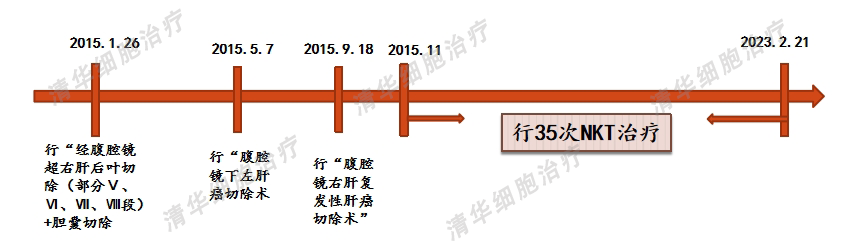
After listening to Professor Zhang's advice, Mr. Yan decided to undergo NKT cell immunotherapy in November 2015. Initially, he received an intensive regimen for 2 months, and then in January 2016, the treatment was changed to one course per month without interruption. After multiple follow-up examinations showed stable conditions, the treatment was adjusted to six courses per year in August 2016. Two years later, in 2018, the treatment was changed to one course every three months. To date, Mr. Yan has completed a total of 35 courses of treatment, with overall stability and no significant recurrence or metastasis observed.


Image aspect


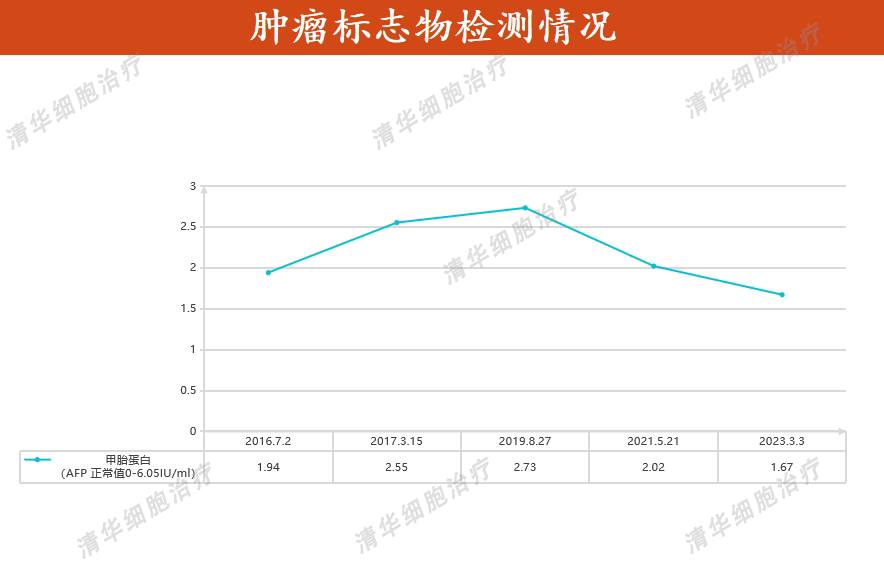
Tumor markers


From July 2016 to March 2023, the AFP levels were within the normal range during follow-up examinations.


 Conclusion and Comments


Mr. Yan's quality of life has been greatly improved. His mental state is excellent, and he feels more energetic and vigorous when doing things, returning to his pre-illness state. His daily life and work have not been affected by the disease. The latest life treatment score is 95.5, and he reports a decrease in skin allergies and an increase in immunity.
Mr. Yan underwent immediate surgical treatment after discovering the tumor, but it still recurred post-surgery, indicating the high malignancy of the tumor. NKT cell therapy provides patients with more options. Follow-up results during multiple treatments also confirm this.
In a study, 354 patients with liver cancer underwent radical hepatectomy and were followed up. The incidence of distant metastasis within 2 years after hepatectomy was higher in the poorly differentiated liver cancer group (21%) compared to the well-differentiated liver cancer group (2%) (P=0.011). Among the poorly differentiated liver cancer group, approximately 40% of patients with tumor size greater than 3cm developed distant metastasis.
Mr. Yan's tumor recurred and underwent further surgery. Despite the high malignancy of the tumor, NKT cell therapy intervention stabilized Mr. Yan's condition. In this process, NKT cell immunotherapy played an indispensable role in reducing the risk of recurrence and metastasis, strengthening the immune system, and thus providing patients with long-term stability.
Popular science knowledge is provided for reference only. Individual patients should follow clinical medical advice.   

Reference:< H352>

【1】Hayato Abe, Kazu Shibutani, Shintaro Yamazaki, Tatsuo Kanda, Mitsuhiko Moriyama, Masahiro Okada, Masahiko Sugitani, Shingo Tsuji, Tadatoshi Takayama, Yukiyasu Okamura, Tumor stiffness measurement using magnetic resonance elastography can predict recurrence and survival after curative resection of hepatocellular carcinoma, Surgery, 10.1016/j.surg.2022.11.001, 173, 2, (450-456), (2023).

NKT Classic Case Review

Click on the image

to view< H384>