Contact Us Careers
Intestine Cancer

Mistakenly treating rectal cancer as hemorrhoids, the patient's condition still metastasized after exhausting traditional treatments. Finally, this method was used to contain the spread

时间:2026-04-27 人气:


If you cannot understand the subsequent professional descriptions, you can finish reading this text in two minutes

Overview of the Disease


Ten years ago, Mr. X's greatest passion was indulging in the world's finest cuisines. However, he noticed blood in his stool and initially mistook it for hemorrhoids, dismissing it as a minor issue, thinking that taking some heat-clearing medication would resolve the issue.
Yet, after more than a year with no improvement, he finally took notice. The colonoscopy revealed the diagnosis - rectal cancer!
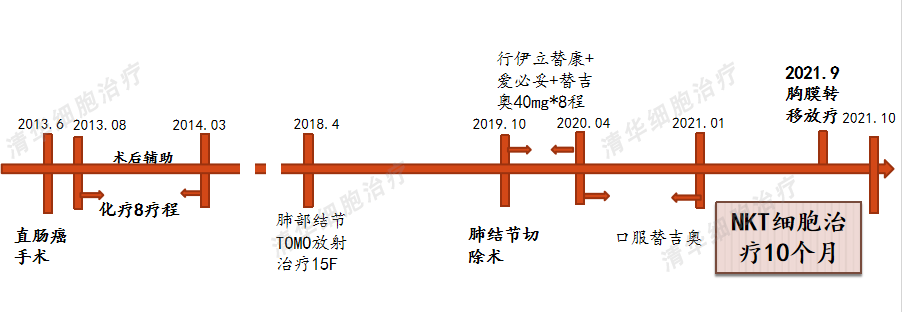
Mr. X underwent radical resection for rectal cancer in July 2013. Postoperative pathology indicated moderately differentiated adenocarcinoma with extensive infiltration, involving the perirectal adipose tissue, accompanied by extensive lymphovascular infiltration. Five perirectal lymph nodes showed tumor metastasis, accompanied by lymphatic and extramural venous infiltration , with a clinical stage of T3N2aM0 (IIIB). Postoperative chemotherapy consisting of eight courses of oxaliplatin and Xeloda was administered.
The disease
Li
   
Small    
Knowledge

Although rectal cancer has a relatively good prognosis among malignant tumors of the digestive tract, Mr. X's pathological report reveals that the tumor had already undergone extensive infiltration at the time of discovery - cancer cells were found infiltrating both lymphatic vessels and extramural veins of the intestinal wall, and there was also metastasis to five lymph nodes. Typically, tumors grow by infiltrating deep into the intestinal wall, where there are abundant lymphatic vessels and blood vessels responsible for lymphatic fluid return and nutrient exchange in the intestine. These vessels lead to various parts of the body, and “infiltration” means that cancer cells have already appeared in these tiny vessels and are migrating outward. Even if radical surgery is performed to remove the main lesion, it indicates a higher risk of future metastasis and recurrence.  
The subsequent progression of the disease also proved this point.
Four years later, in March 2018, Mr. X underwent a chest CT scan and discovered three nodules in his right lung, confirming lung metastasis from rectal cancer.
Despite undergoing treatment according to the standard protocol, a second metastasis of the tumor was unavoidable.
He had to undergo another round of treatment - in April 2018, he received TOMO radiation therapy for the lung nodules. In January 2019, he underwent resection for the remaining lung nodules.
The third metastasis came even more unexpectedly! Just nine months later, Mr. X's PET/CT scan revealed the emergence of carina lymph node metastasis. He had no choice but to undergo carina lymph node resection and receive treatment with Irinotecan + Erbitux + S-1.

After experiencing multiple recurrences and metastases, Mr. X was physically and mentally exhausted from multiple surgeries and chemoradiotherapy. If there were any new metastases, traditional methods would only lead to this endless cycle of treatment.
Mr. X was resistant to accepting such a conclusion. However, the risk of a fourth metastasis still exists, and his body is unable to withstand the side effects of more surgery and chemoradiotherapy. Therefore, Mr. X hopes to have new treatment options available.
After extensive research, Mr. Xu and his family learned about the NKT technology from Professor Zhang Minghui of Tsinghua University School of Medicine through a friend's recommendation, and conducted a detailed inquiry into the demonstrated cases of NKT cell therapy, with a particular desire to try it to solve the problem of continuous recurrence and metastasis.
After reviewing Mr. X's medical records, Professor Zhang Minghui made the following analysis and judgment:
1. The patient has undergone conventional radical surgery to remove visible lesions, but the vascular and lymphatic infiltration indicated in the pathological results suggests a high risk of recurrence and metastasis.
2. Subsequent multiple metastatic recurrences confirmed the risks indicated by the pathological results. Fortunately, patients with multiple metastatic lesions underwent radical treatment through radiotherapy and surgery.  This significantly reduced the tumor burden, creating favorable prerequisites for cellular immunotherapy.  
3. Even if there are no visible lesions now, the patient still faces a high risk of developing new metastatic lesions. "Grow one, remove one" is not a viable solution. NKT cell therapy is suitable for a wide range of diseases and utilizes the body's own immune cells to eliminate residual "invisible tumor cells," thereby reducing the risk of metastasis and recurrence. Additionally, it has minimal side effects and is highly compatible and friendly to patients.  
Mr. X decided to undergo NKT cell immunotherapy in January 2021, with a regimen of one course per month. So far, he has completed 14 courses, totaling 10 months (as of October 2021).

Image aspect


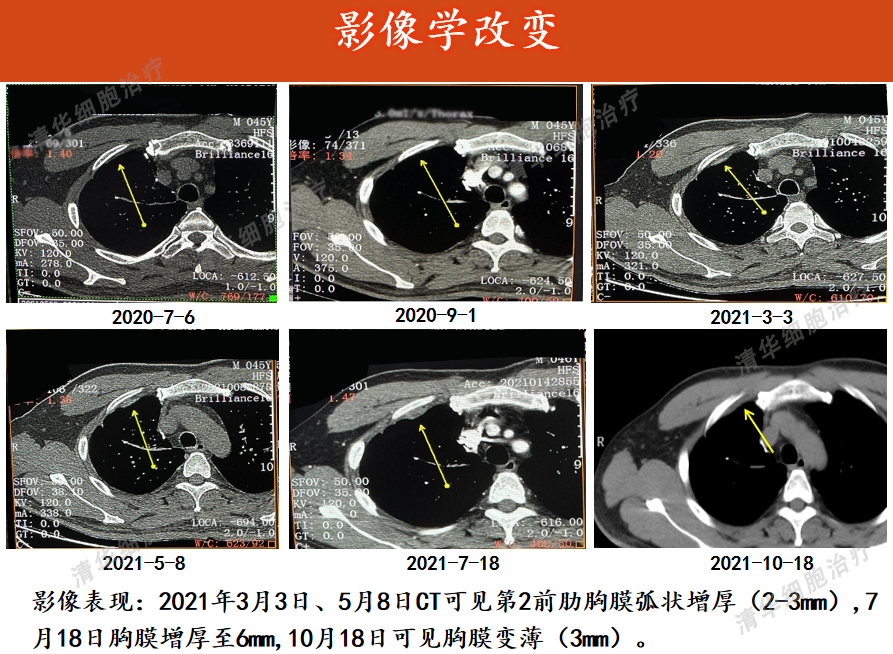
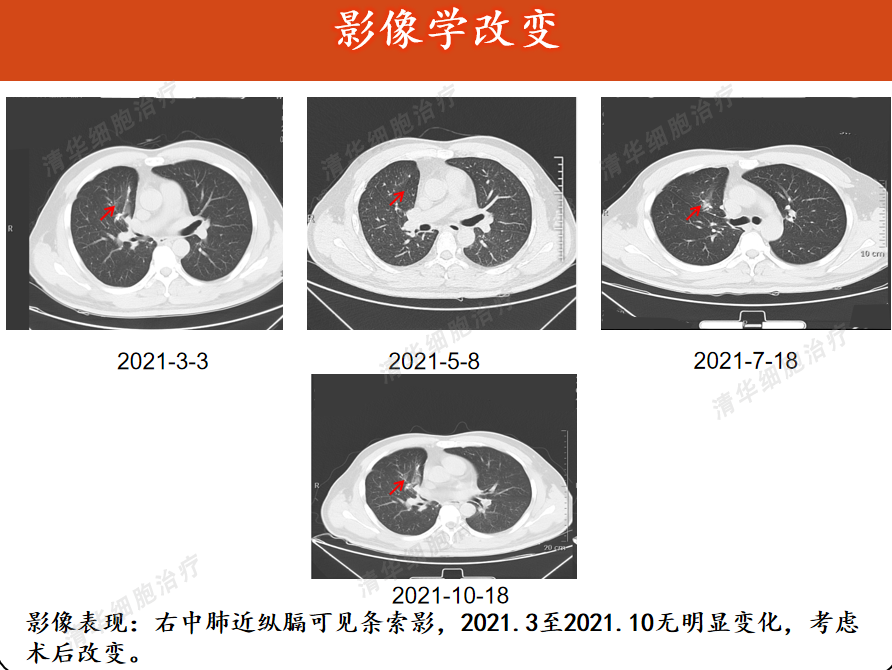
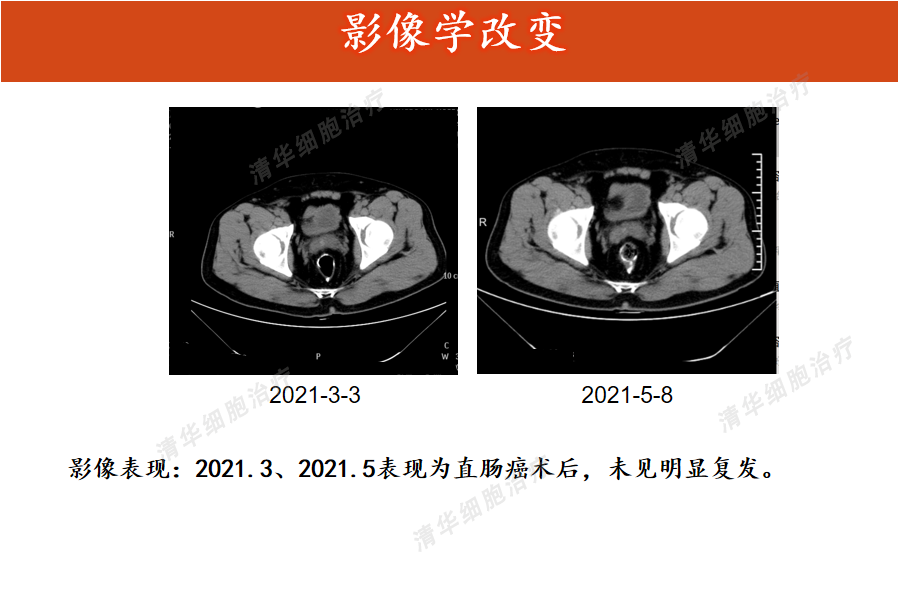
The abdominal CT scan showed postoperative changes of rectal cancer; the chest CT scan showed postoperative changes of metastatic cancer in the right lung, with visible streaky shadows. Two small nodules were visible at the right diaphragmatic dome without significant changes; a follow-up examination in July 2021 revealed local thickening of the right pleura, which returned to normal in an examination in October 2021. Considering the medical history, it was considered to be a post-treatment change.


Tumor markers


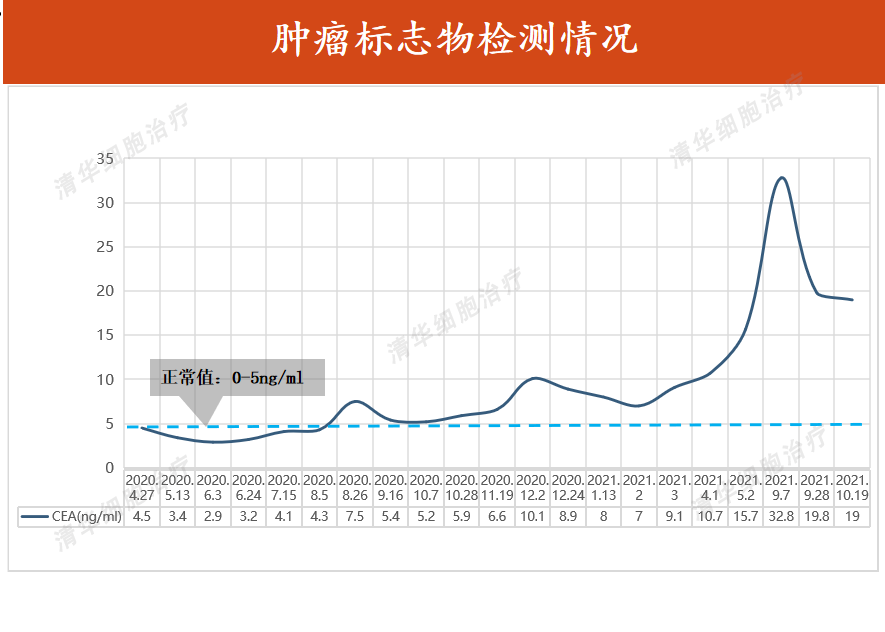
Tumor marker changes: Re-examination of CEA from April 27, 2020 to August 5, 2020 showed no significant abnormalities. From August 26, 2020 to May 2021, it was slightly higher than normal (with overall fluctuations). In September 2021, it increased significantly, but quickly fell back in October, and continued to be observed mainly.


Quality of Life


During this follow-up, Mr. X returned to his normal life and work routine. Due to a dietary adjustment favoring a vegetarian diet, his weight decreased, but his quality of life and mental and sleep conditions remained excellent. The score for this assessment is 84.5 points.


   Conclusion  


Mr. X's ten-year experience with cancer treatment proves that even after conventional treatment, tumor recurrence and metastasis are common. Therefore, the most important approach is to suppress the activity of cancer cells and prevent the continuous emergence of new lesions.
NKT cell immunotherapy serves as an important complement to traditional treatment methods! It plays a crucial role in relying on the immune system to suppress tumor "resurgence".
Our numerous treatment cases also confirm this. Let's look forward to Mr. X's follow-up report next year!

Popular science knowledge is provided for reference only, and individual patients should follow clinical medical advice.                    

NKT Classic Case Review

Click on the image

to view