Contact Us Careers
Breast Cancer

I can't take targeted drugs or endocrine drugs for triple-negative breast cancer, and chemotherapy has severe side effects. What should I do?

时间:2026-04-27 人气:


If you cannot understand the subsequent professional description, you can just read this text in two minutes

Disease Overview


Ms. Lu, on April 7, 2020, underwent a puncture biopsy due to bleeding from her right breast, revealing invasive breast cancer.
On April 15, 2020, 1. A right simple mastectomy was performed, and the postoperative pathology indicated: invasive ductal carcinoma of the breast, stage II. Immunohistochemical results: ER (-), PR (-), Her-2 (2+). Fluorescence in situ hybridization (FISH) results: no amplification of the Her2 gene was detected.
This is what we commonly refer to as triple-negative breast cancer.
Department
Pu
small      
stick

breast cancer is different from other tumors. The prognosis of breast cancer is not only related to the degree of tumor differentiation, but also related to estrogen/progesterone. If ER and PR are negative, endocrine therapy cannot be used; HER-2 receptor can control cell growth and division, while HER-2 negative results in the inability to choose targeted drugs for treatment. Neither endocrine therapy nor appropriate targeted drugs are available, and compared with other types of breast cancer, it is more malignant and prone to recurrence and metastasis. At present, there is no targeted standard treatment scheme.  


After completing surgery, Ms. Lu faced the challenge of choosing an adjuvant therapy. Her ER and PR status were both negative, indicating that endocrine therapy was ineffective. She could only undergo a standard 4-cycle chemotherapy regimen consisting of epirubicin and cyclophosphamide. However, due to the severe side effects of chemotherapy, Ms. Lu only completed one cycle and discontinued it.
Endocrine therapy was not an option, chemotherapy side effects were too severe, and targeted therapies were not applicable. Under these circumstances, even with surgery, there might still be residual cancer cells that could potentially recur and metastasize in the future.  
Ms. Lu was deeply concerned. Subsequently, upon the recommendation of friends, Ms. Lu and her family learned about Professor Zhang Minghui's NKT technology at Tsinghua University School of Medicine and conducted a detailed search for NKT cell therapy case presentations , particularly hoping to try it out to address the potential risks in the future.  


After reviewing Ms. Lu's medical records, Professor Zhang Minghui made the following analysis and judgment:
1. Although the patient underwent radical mastectomy and the primary visible lesion was removed during surgery, the risk of recurrence and metastasis for "triple-negative" breast cancer is extremely high. The patient also has no other good treatment options available.
2. According to the treatment guidelines, chemotherapy should be administered. However, the patient cannot tolerate the side effects of chemotherapy and faces the dilemma of having "no medication to treat the condition".
3. The applicable conditions for NKT cell therapy are not limited by gene mutations. Its main goal is to enhance the "monitoring" and "defense" functions of the entire immune system - microscopically, to kill those tiny residual tumor cells (click to view How do NKT cells kill tumor cells? After watching this set of experimental videos from Tsinghua University, you will know), and macroscopically, patients can observe the effect of preventing (delaying) recurrence and metastasis. At the same time, cellular immunotherapy has no side effects, is "friendly" to patients, and does not cause intolerance.    
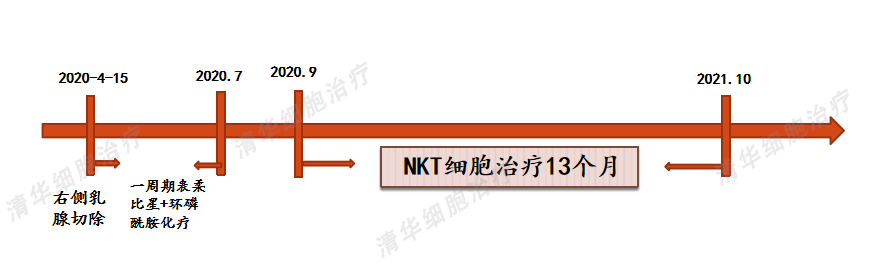
Ms. Lu began NKT cell therapy in September 2020, with a regimen of one course per month. By October 2021, she had completed nine courses over a 13-month period. During this year-long treatment, no signs of recurrence or metastasis were detected during follow-up examinations.


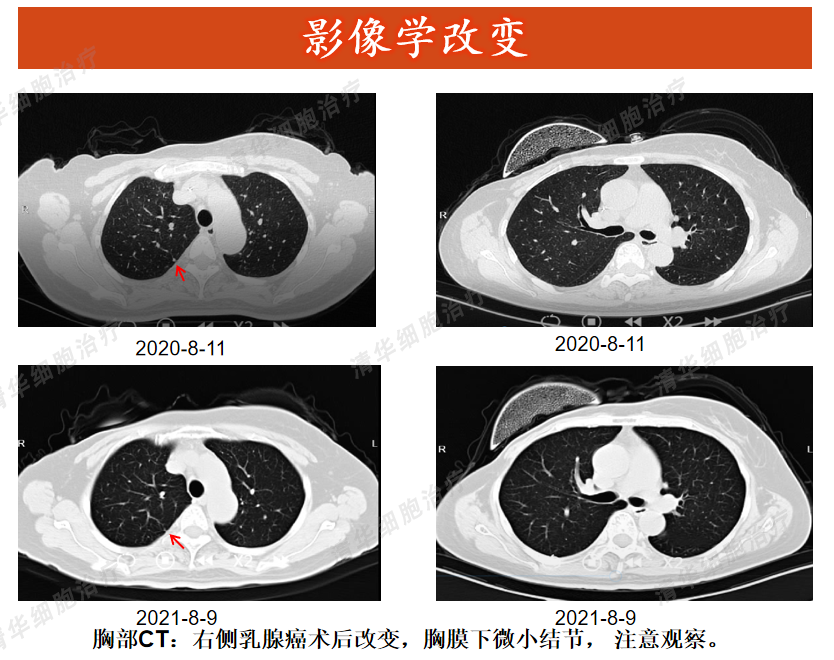
Image aspect


On August 9, 2021, chest CT showed postoperative changes of right breast cancer. On July 3, 2021, ultrasound examination revealed lobular hyperplasia of the left breast, with no other significant abnormalities observed, and the evaluation was stable.


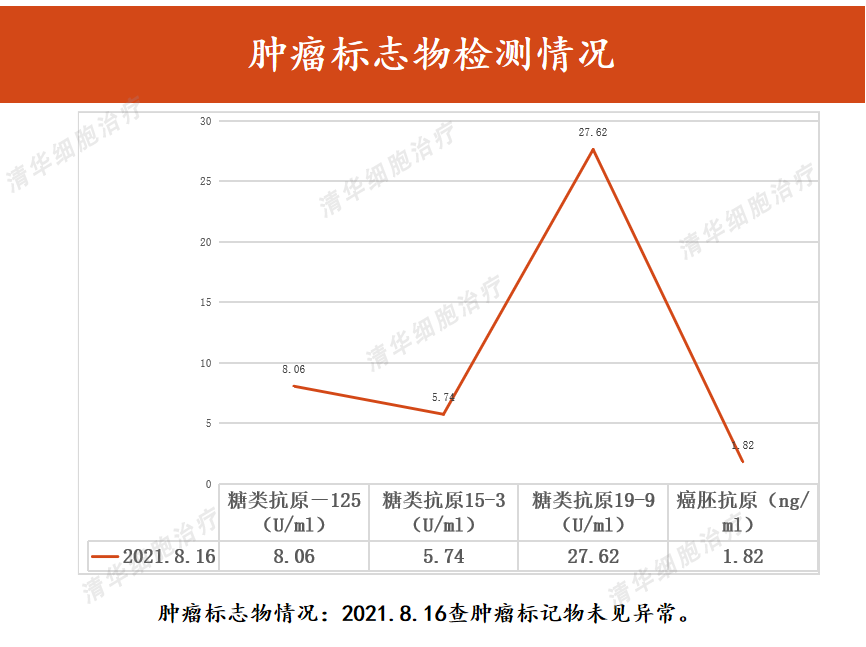
Tumor markers


Tumor marker test: On August 16, 2021, tumor markers were tested and no abnormalities were found.


Quality of Life


During the 13-month treatment, Ms. Lu's fatigue from previous chemotherapy disappeared, her physical condition improved, her physical strength increased, and she returned to normal daily life. Her quality of life score was 83 points.  


   Conclusion 


Patients with breast cancer often have no choice but to wait for death if endocrine therapy, chemotherapy, and targeted therapy are all unsuccessful. However, NKT cell therapy starts with the immune system and utilizes NKT cells to kill tumor cells while causing almost no side effects. After undergoing 9 courses of treatment over 13 months, Ms. Lu showed no signs of recurrence or metastasis, and her overall condition was assessed as stable.
Let's look forward to her treatment demonstration next year!  

Popular science knowledge is provided for reference only, and individual patients should follow clinical medical advice.                  

NKT classic case review

Click on the image

to view


上一篇:没有了