About Lehe
乐于心,和与众,与己乐,与人和; 心宽念纯,百病无生。


乐于心,和与众,与己乐,与人和; 心宽念纯,百病无生。


Esophageal cancer is a malignant tumor of the digestive system, ranking seventh in incidence rate and sixth in mortality rate among global cancers. In China, the incidence rate of esophageal cancer ranks seventh, while its mortality rate ranks fifth. Its incidence and mortality rates in China are second only to lung cancer, liver cancer, gastric cancer, and colorectal cancer [1]. After being diagnosed with esophageal cancer, Mr. Zhao did not undergo radiotherapy or chemotherapy due to the unbearable side effects. However, he was worried about recurrence and metastasis. He underwent chemotherapy repeatedly, but his condition deteriorated day by day. Yet, he dared not stop the treatment. How can he achieve a treatment plan that mitigates side effects while ensuring efficacy
Disease Overview
In October 2021, Mr. Zhao presented with "dysphagia upon eating and discomfort in the right chest". Endoscopic ultrasonography revealed early-stage carcinoma (T1) in the mid-esophagus. On November 2, he underwent endoscopic submucosal dissection (ESD) of the esophagus. Postoperative pathology showed high-grade epithelial neoplasia, with focal malignant transformation into moderately differentiated squamous cell carcinoma, accompanied by involvement of the esophageal glandular ducts. The gross tumor type was Type 0-IIb, with a total (microscopic) lesion size of 3.3x3cm, including a squamous cell carcinoma lesion size of 3.3x1.3cm. The histological type of the deepest infiltrating cancer tissue was moderately differentiated squamous cell carcinoma, and the infiltration pattern was INFb.
Due to the extensive tumor involvement and deep infiltration, Mr. Zhao decided to undergo further surgical resection and clearance. On December 23, he underwent robot-assisted partial esophagectomy, esophagogastric cervical anastomosis, lymph node dissection, and bilateral recurrent laryngeal nerve dissection. Metastatic squamous cell carcinoma was found in the lymph nodes (4/37), without involvement outside the lymph node capsule.
How can we consolidate the condition without undergoing chemotherapy and radiotherapy?
Mr. Zhao has undergone two surgical traumas and is now elderly, making it difficult for him to bear the side effects of chemotherapy and radiotherapy. After comprehensive consideration with his family, he decided to forgo postoperative chemotherapy and radiotherapy. To achieve a good prognosis, Mr. Zhao has been seeking alternative treatment methods to prevent recurrence and metastasis. He learned that Professor Zhang Minghui's vNKT cell therapy is highly suitable for his current needs. Compared to chemotherapy and radiotherapy, vNKT cell therapy has fewer side effects and belongs to systemic treatment with a long-lasting immune tail effect, allowing patients to achieve a higher quality of life.
After systematic evaluation by the team, the second consultation advice from Lehe New Medical is given as follows:
1. Mr. Zhao's pathological type is squamous cell carcinoma. Compared to other types of esophageal cancer (mainly adenocarcinoma), esophageal squamous cell carcinoma has a poorer long-term survival rate. Currently, radical resection of the esophagus is the main method for treating esophageal squamous cell carcinoma, but the prognosis is still unsatisfactory [2].
2. Due to the extensive tumor involvement and deep infiltration, Mr. Zhao underwent radical surgery again, and pathology has shown lymph node metastasis. Without undergoing chemotherapy and radiotherapy, there is a high risk of recurrence and metastasis.
3. After reducing tumor burden through surgery, timely intervention with vNKT cell therapy can clear residual cancer cells and rapidly enhance the body's immune system.
4. Treating cancer begins with treating the mind. Combined with Lehe's comprehensive rehabilitation methods, establish a positive mindset, change unhealthy eating habits, and gradually return to normal life.
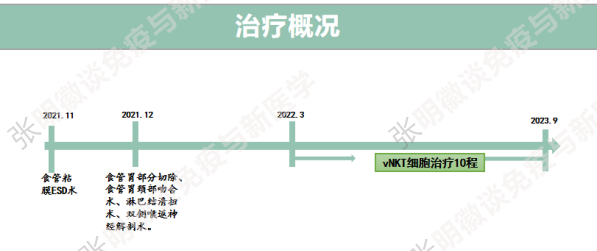
Mr. Zhao started vNKT cell therapy in March 2022. The first-stage treatment plan: one course per month, and he has completed 10 courses so far. Up to now, he has been in a stable condition for two and a half years.
Analysis and Commentary
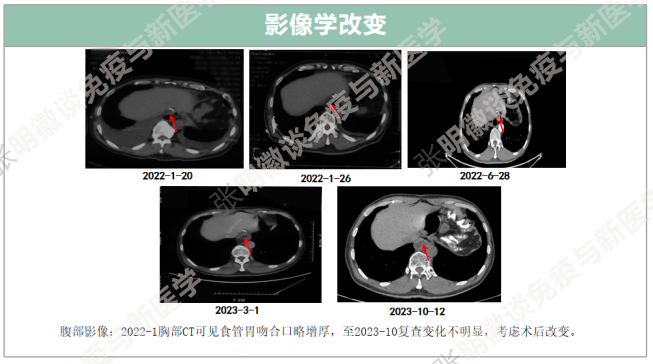
Given Mr. Zhao's condition, which involves lymph node metastasis and a poor pathological type, the risk of recurrence and metastasis is extremely high. If there is recurrence or metastasis, it will lead to endless chemotherapy and radiotherapy, causing the immune system to collapse and the tumor to become uncontrollable. Under the treatment of vNKT cells combined with Lehe's comprehensive rehabilitation program, Mr. Zhao's condition has stabilized without recurrence. He is energetic, his body's resistance has increased, the frequency of colds has decreased compared to before, and he is gradually returning to normal social life.
For most cancer patients, chemotherapy and radiotherapy are important methods in cancer treatment. Treatment plans need to be tailored to the actual situation of the patient, with the goal of maintaining overall stability in the patient's body. Not only should attention be paid to tumor removal, but also to comprehensive measures such as diet, exercise, lifestyle habits, and emotional state, to ensure an enhanced immune system and the ability to fight cancer cells for a long time.

Contact Us
Scan QR Code
Communicate with Professor Zhang Minghui's Team
Reference Sources:
[1] Wang Shaoming, Zheng Rongshou, Han Bingfeng, et al. Analysis of the Age Characteristics of Incidence and Mortality of Malignant Tumors in the Chinese Population in 2022 [J]. China Cancer, 2024, 33(03):165-174.
[2] [5] Xia Lingling, Wang Jing, Fan Xiangli, et al Treatment efficacy, survival status, and prognostic factors of patients with superficial esophageal squamous cell carcinoma [J]. Journal of Wuhan University (Medical Edition), 2023, 44(10): 1204-1208.
Edited/typeset by: Zhao Runtuan
Medically reviewed by: Wang Ying
Address: Room 1101 (Unit 101), 11th Floor, Building 1, No. 7 Courtyard, Kexueyuan Road, Life Science Park, Changping District, Beijing
Phone:010-8265 9866
Email:lehemedneo@hotmail.com