Contact Us Careers
Lung Cancer

"Breaking the norm, the patient's lung cancer has not recurred or metastasized five years after surgery, thanks to this method."

时间:2026-04-27 人气:


If you find it difficult to understand the subsequent professional descriptions, you can easily grasp the essence of this text within two minutes. Mr. Li did not receive any other anti-tumor treatments after his surgery, and his treatment background is relatively straightforward, making it easy to evaluate the effectiveness of NKT cell therapy. We have previously showcased Mr. Li's case (click on the blue text to view "Preventing Recurrence and Metastasis After Lung Cancer Surgery"). In the new year, will he continue to maintain his "excellent performance"

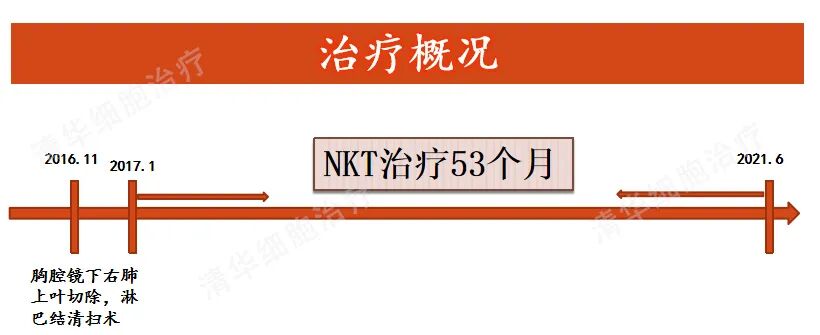
Mr. Li discovered a shadow in his right lung during a physical examination in October 2016, and underwent thoracoscopic resection of the right upper lobe in November. Pathology revealed peripheral infiltrating adenocarcinoma in the right upper lobe.
Compared to the common clinical manifestations of squamous cell carcinoma of the lung, adenocarcinoma appears later. Fortunately, Mr. Li's tumor was discovered during a physical examination, indicating an early stage.

However, due to negative genetic testing results, there is no specific targeted drug, and the risk of future recurrence and metastasis has not been eliminated. However, the patient is resistant to chemotherapy, so Mr. Li needs to find a maintenance therapy that can prevent recurrence and metastasis without significant side effects.

Fortunately, Mr. Li's friend, Mr. Wang, has been diagnosed with advanced bile duct cancer. Mr. Wang has experienced a recurrence of bile duct cancer one year after surgery, and his liver cancer has also recurred repeatedly. However, after receiving NKT cell therapy from Professor Zhang Minghui of Tsinghua University, the tumor development was successfully suppressed, and there has been no recurrence or metastasis for over five years! Therefore, Mr. Li made a prompt decision to undergo NKT cell therapy immediately after surgery and has continued to do so ever since. After understanding Mr. Li's condition, our team formulated a treatment plan of one course per two months, with the main goal of preventing recurrence and metastasis. The efficacy evaluation indicator is progression-free survival (PFS). As of June 2021, after 26 consecutive courses of systematic treatment and regular follow-up with lung CT scans, head and abdominal magnetic resonance imaging, the patient has shown no clear signs of recurrence or metastasis for 53 consecutive months.


Imaging Findings:
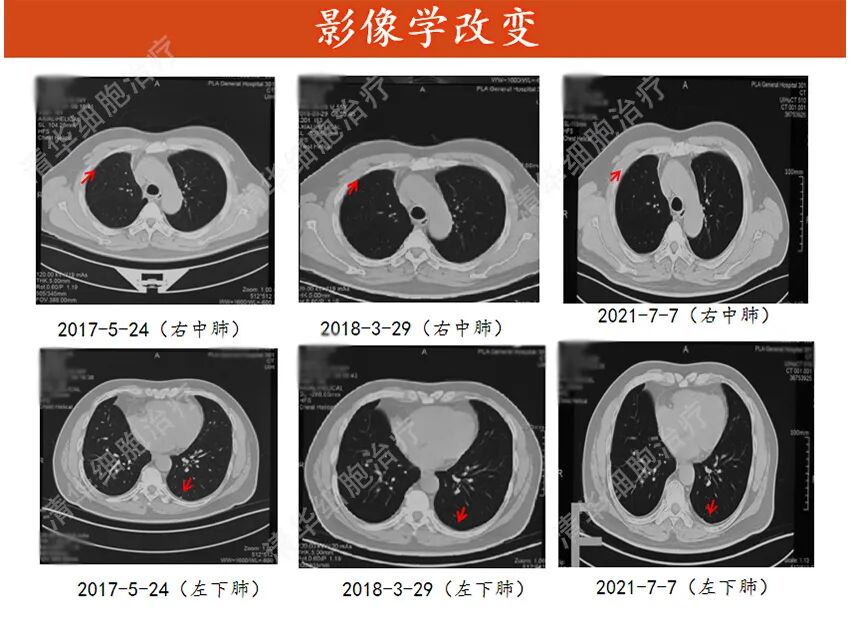
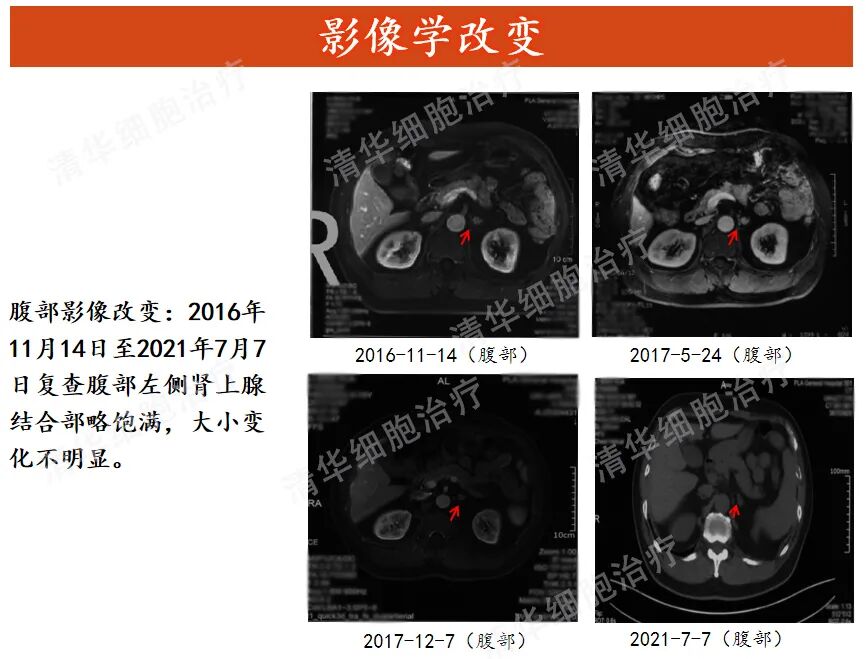
Regular follow-up lung CT scans from May 2017 to July 2021 showed no significant changes. Magnetic resonance imaging (MRI) of the head, abdomen, and prostate from November 2016 to July 2021 also revealed no clear signs of tumors.
On July 8, 2021, a prostate MRI was performed, revealing an enlarged prostate measuring approximately 55*36*43mm. Benign prostatic hyperplasia and prostatitis are suspected, and close observation is advised.
Chest Imaging Findings: From May 24, 2017, to July 7, 2021, follow-up chest CT scans showed no significant changes in subpleural nodules in both lungs, and no notable changes in localized pleural thickening on the right side. Re-examination is advised.
Tumor Marker Findings:
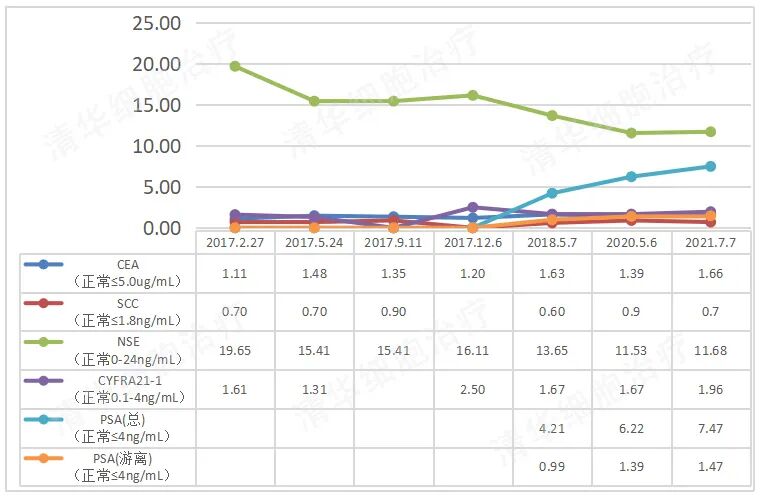
Tumor marker changes: From February 2017 to July 2021, carcinoembryonic antigen (CEA), neuron-specific enolase (NSE), squamous cell carcinoma antigen (SCC), and CYFRA21-1 were all within the normal range.
Total prostate-specific antigen (PSA) levels were higher than normal from May 2018 to July 2021, while free PSA levels were within the normal range. Considering the patient is a middle-aged male, and PSA is a tumor marker associated with prostate cancer, close observation is necessary.
Quality of Life:

In this follow-up, Mr. Li remains in good health as usual, with stable weight, good sleep and appetite, and continues with his daily work. His quality of life score this time is 89, an improvement from the previous score of 83.

Mr. Li was diagnosed with lung adenocarcinoma in 2016 and underwent timely surgery. It has been 5 years since the tumor was found to have recurred. After 26 consecutive courses of NKT cell therapy, regular follow-up CT scans of the lungs, head, abdomen, and prostate magnetic resonance imaging showed no clear signs of tumor, and his progression-free survival (PFS) reached 53 months.

NKT Classic Case Review

Click on the image

to view