Contact Us Careers
Lung Cancer

Malignant lung cancer recurred three years after surgery, but has now been stably managed for 78 months

时间:2026-04-22 人气:

If you cannot understand the subsequent professional description, you can finish reading this text in two minutes

Disease Overview


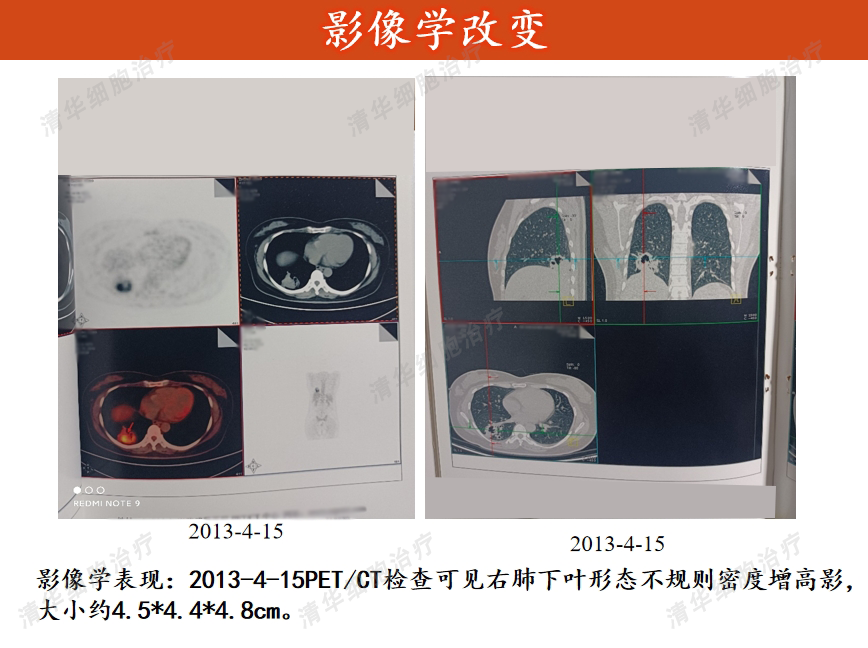
In April 2013, Ms. Zhong underwent a physical examination and discovered a shadow in her right lower lung. A biopsy was performed, revealing a well-differentiated adenocarcinoma with a component of mucinous adenocarcinoma in the right lower lung. Upon discovering the lesion, Ms. Zhong promptly underwent a radical resection of the right lower lung cancer via Video-Assisted Thoracoscopic Surgery (VATS). Postoperative pathology indicated (right lower lung) invasive mucinous adenocarcinoma, with cancer tissue infiltrating the visceral pleura and bronchial wall. Immunohistochemistry revealed NapsinA (+), TTF1 trace (+), EGFR-19 (-), and EGFR-21 (-). Postoperative chemotherapy was routinely administered using the L-OHP regimen.
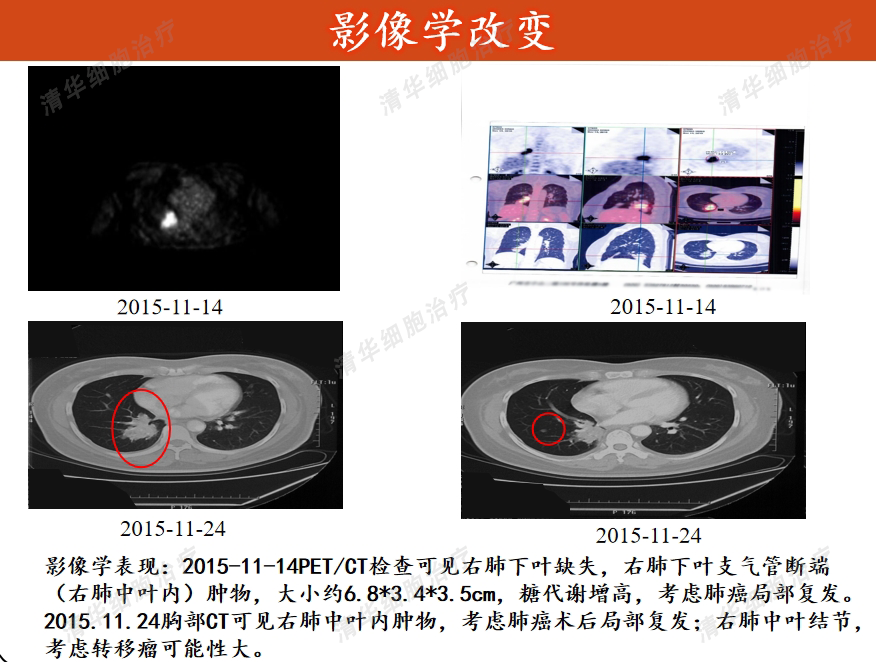
It was initially believed that surgery combined with chemotherapy could eliminate the tumor. However, in 2015, another mass was discovered. In November 2015, under general anesthesia, a resection of the right lower lobe and middle lobe of the lung was performed. Pathological diagnosis indicated invasive mucinous adenocarcinoma, primarily presenting as alveolar, mural, and papillary patterns, involving the visceral pleura and segmental bronchi, but not the lobar bronchi. No clear vascular tumor thrombus or nerve invasion was observed. Immunohistochemical results showed ALK-D5F3 (-), ALK-Neg (-), BRAF-V600E (-), EGFR-19DEL (-), EGFR-L858R (-) HER2 (2+), and c-MET (2+).
Department

Pu    
small
   
Knowledge
   

knowledge


Mucinous adenocarcinoma of the lung

According to the WHO histological classification, lung adenocarcinoma can be divided into mixed type, alveolar type, papillary type, bronchioloalveolar carcinoma type, adenocarcinoma with mucin secretion, and some variant types. Mucinous adenocarcinoma of the lung (MPA) is a special subtype of lung adenocarcinoma, characterized histologically by the presence of abundant mucin within the tumor, with unique clinical pathological features and immunophenotypes.

The overall prognosis of MPA is worse than that of other subtypes of lung adenocarcinoma, possibly due to its higher metastatic rate, including intrapulmonary metastasis, hematogenous metastasis, and lymphatic metastasis.

Ms. Zhong underwent chemotherapy after surgery, but relapsed in the third year and had to undergo another surgery. In order to achieve a longer stable period, Ms. Zhong sought help from Professor Zhang Minghui's team.
After carefully reviewing Ms. Zhong's medical records, Professor Zhang Minghui made the following analysis and judgment:

1. The patient was diagnosed with lung cancer in 2013 and underwent surgical treatment. The tumor was mucinous adenocarcinoma of the lung, which is relatively rare clinically and has a poor prognosis.

2. The patient's first surgery revealed no lymph node metastasis and was staged relatively early, yet recurrence occurred two years later.

3. Apart from specific pathological types, involvement of visceral pleura and segmental bronchi is also a risk factor for future recurrence.

4. NKT therapy utilizes powerful immune cells to eliminate tumor cells that may remain undetected in the body, with essentially no side effects. Combining NKT cell therapy after surgical treatment can effectively inhibit tumor growth, prolong survival, and improve quality of life.
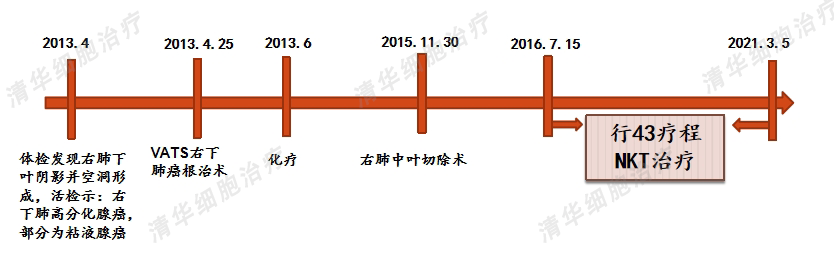
In 2016, Ms. Zhong began NKT cell therapy, and by March 2021, she had completed 43 courses of treatment. Multiple follow-up examinations showed no clear signs of tumor recurrence, and her overall condition remained stable.


Imaging
,  


 Conclusion and Comments


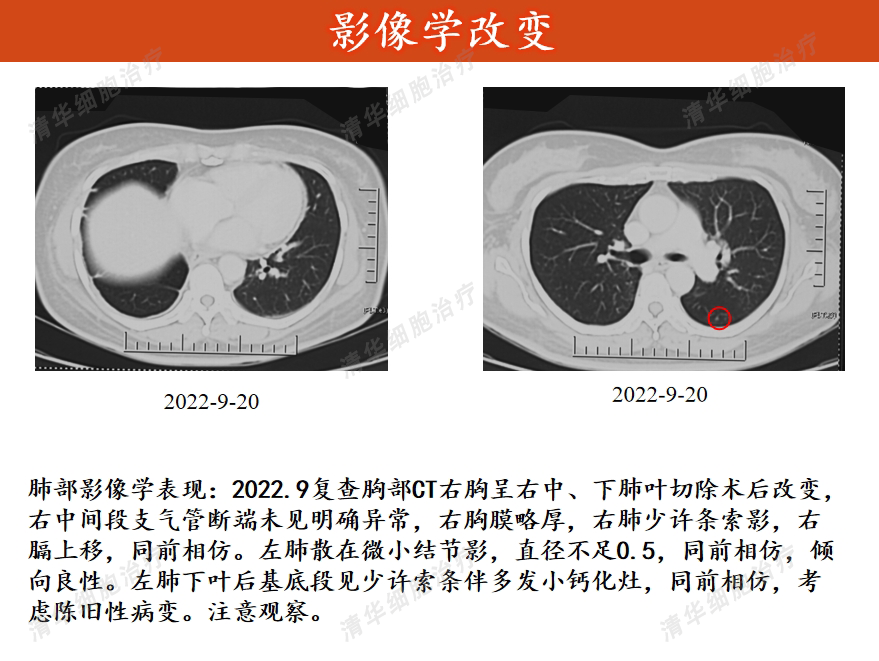
During the years of treatment, the results of Ms. Zhong's multiple follow-ups have been satisfactory and reassuring. We look forward to more good news from subsequent treatments and follow-ups.
Lung cancer is one of the most common malignant tumors, among which lung mucinous adenocarcinoma has a poor prognosis. According to relevant research, the 1-year, 3-year, and 5-year progression-free survival rates for lung adenocarcinoma producing mucin are 85%, 64%, and 38%, respectively; the overall survival rates are 90%, 67%, and 50%, respectively.
Ms. Zhong has undergone two surgical treatments, indicating that this particular type of tumor has a high degree of malignancy. NKT cell therapy not only eliminates residual tumor cells but also strengthens the immune system, thereby providing patients with long-term stability.
Popular science knowledge is provided for reference only. For individual patients, clinical treatment should prevail.   

Reference:< H303>

【1】Qu, Y., Zhao, D., Mu, J., Che, N., Zhang, C., Liu, Z., Su, D., Zhou, L., Zhang, H., & Wei, L. (2016). Prognostic analysis of primary mucin-producing adenocarcinoma of the lung: a comprehensive retrospective study. Tumour biology : the journal of the International Society for Oncodevelopmental Biology and Medicine, 37(1), 887–896.
NKT Classic Case Review

Click on the image

to view< H336>