About Lehe
乐于心,和与众,与己乐,与人和; 心宽念纯,百病无生。


乐于心,和与众,与己乐,与人和; 心宽念纯,百病无生。

▲Click on the blue text to follow us
It is widely known that the occurrence of cancer is caused by gene mutations. Targeted drugs, on the other hand, prevent the growth of cancer cells by targeting specific "targets" on them. However, cunning cancer cells can also undergo corresponding changes, leading to a decrease in sensitivity to targeted drugs and resulting in drug resistance.
Targeted drug resistance can be divided into two types: primary resistance and secondary resistance. Primary resistance refers to the presence of other gene mutations in the patient, which leads to poor treatment efficacy with targeted drugs. Secondary resistance, on the other hand, occurs when tumors undergo other gene mutations during targeted drug treatment in order to evade the drug's effects, resulting in drug resistance.
Targeted drug resistance is also known as drug resistance. Once it occurs, the efficacy of targeted drugs will significantly decrease. If resistant drugs are continued to be used, not only will they not benefit the treatment outcome, but they may also increase the risks associated with drug side effects.
How to deal with resistance to targeted drugs
Ms. Liu was diagnosed with lung cancer in 2020 and underwent a 3D thoracoscopic lobectomy (right upper lobe) + thoracoscopic mediastinal lymph node dissection under general anesthesia. Postoperative pathology revealed: (right upper lobe) invasive adenocarcinoma, with a maximum tumor diameter of 6cm, satellite foci around the tumor, involvement of the bronchial wall and pleura, visible airway dissemination, and positivity in the fourth group of lymph nodes. Genetic testing revealed: CTNNB1 mutation type SNV exon 3 mutation site G34A, mutation frequency 47.11%; EGFR mutation type InDel exon 19 mutation site E746-A750del, mutation frequency 30.46%.
The patient was found to have EGFR mutations and started taking erlotinib treatment. In November of the same year, due to intolerance, she switched to taking Icotinib. In September 2021, a follow-up lung CT scan revealed two small nodules in the upper segment of the right lower lobe, suggesting metastatic disease. Considering that the original targeted drug had developed resistance, she switched to taking Amatinib and has been on it ever since.
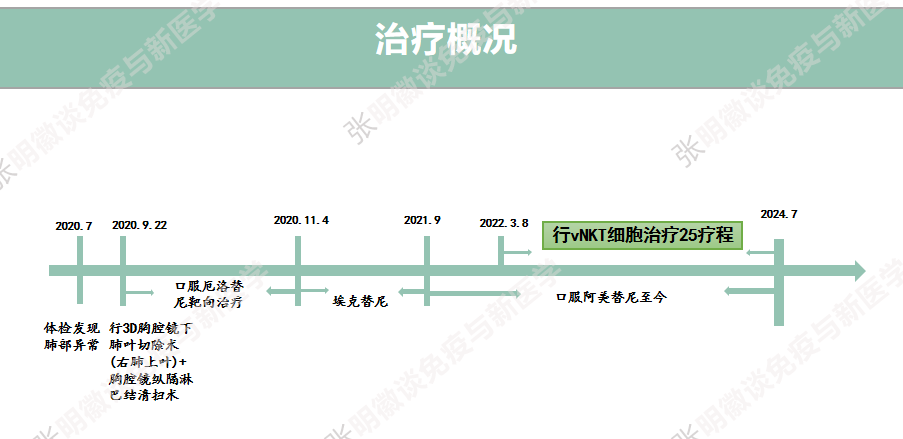
Based on Ms. Liu's case, let's explore the solutions to targeted drug resistance.
1. Strictly follow the instructions for taking targeted drugs
The medication time is determined through extensive clinical trials. Some drugs are taken on an empty stomach, while others are taken half an hour after a meal. This is due to pharmacokinetics, which requires maintaining a stable blood drug concentration. Therefore, it is essential to strictly follow the instructions and avoid discontinuing medication, as this can delay the emergence of drug resistance in targeted drugs.
2. Switching to a new generation of targeted drugs
The differences between the three generations of targeted drugs: The first and second generation targeted drugs are classified based on the strength of their binding to the target and whether it is reversible; while the third generation targeted drugs are specifically developed for specific gene mutations (T790M) that occur after resistance to the first or second generation drugs. Theoretically, each generation is "stronger than the previous one." Patients undergoing targeted therapy usually start with the first generation of targeted drugs. If the first generation fails, the second or third generation can be used, and often shows some effect. The targeted drugs that Ms. Liu first used, Icotinib and Icotinib, are first-generation targeted drugs, while the later-replaced Amatinib belongs to the third-generation targeted drugs.

3. vNKT cell therapy combined with targeted drugs
Some research data have found that combining targeted therapy with chemotherapy, radiotherapy, immunotherapy, etc. can achieve synergistic anti-cancer effects, not only improving treatment outcomes but also delaying the occurrence of drug resistance.
Ms. Liu took corresponding targeted drugs for treatment after surgery, but new lesions still appeared in the second year and were considered to be possibly metastatic. She was concerned that the targeted drugs were difficult to suppress the tumor, and had already switched to third-generation targeted drugs. If drug resistance occurred again, the choices of drugs would become increasingly limited. After contacting Professor Zhang Minghui's team, the Lehe New Medical team provided a comprehensive evaluation and second diagnosis and treatment suggestion:
1. Ms. Liu's tumor was large at the time of diagnosis, with a maximum diameter of 6cm and late-stage lymph node metastasis.
2. Pathological findings revealed tumor involvement of the bronchial wall and pleura, as well as intrapulmonary dissemination, which greatly increased the probability of future recurrence and metastasis.
3. The patient was found to have gene mutations and was treated with targeted drugs, but new lesions still appeared in the second year, suggesting resistance to the original targeted drugs. The patient was switched to Amatinib.
4. Combining targeted drugs with vNKT cell therapy can prolong the time before targeted drug resistance occurs, eliminate residual cancer cells in the body, and prevent recurrence and metastasis.
Ms. Liu began using vNKT cell therapy in March 2022 and has completed a total of 25 courses of cell therapy so far. During this period, she continued to use the targeted drug Amatinib for 3 years without experiencing drug resistance, achieving long-term stable efficacy. The treatment is still ongoing.
vNKT cells possess both the non-specific recognition function of NK cells and the specific recognition function of CD8 T cells. Therefore, the dual anti-tumor effect of vNKT cells allows for the rapid killing of tumor cells. It not only directly kills cancer cells but also kills inhibitory immune cells (Myeloid-derived suppressor cells, MDSCs are a heterogeneous group of cells derived from the bone marrow, capable of significantly inhibiting immune cell responses and negatively regulating immune responses.) and regulating the microenvironment within cancer tissues.The combination of vNKT cells and targeted therapy achieves a synergistic effect where 1+1>2. Ms. Liu reported an increase in hair volume, improvement in hair quality, turning of hair color to black, and a reduction in skin allergy frequency. We look forward to continued good news from subsequent treatments and follow-ups.
In summary, resistance to lung cancer targeted drugs is a complex and unavoidable issue. Ms. Liu's treatment experience provides valuable insights, demonstrating a diverse strategy to address resistance, from strictly following medication instructions, to timely switching to alternative targeted drugs, to innovatively using vNKT cells in combination with targeted drugs. This not only brings hope to patients but also accumulates experience for the development of lung cancer treatment. We believe that with the continuous advancement of medical research, we can find more effective ways to combat resistance to lung cancer targeted drugs, allowing more patients to regain their health.
Click on the image to view the exciting content from previous issues

Contact Us
Scan QR Code
Communicate with Professor Zhang Minghui's Team
Written by: Zhao Tuantuan
Reviewed by: Wang Ying, Gao Chen, Qiao Jiacheng
Edited/Typeset by: Zhao Tuantuan

Address: Room 1101 (Unit 101), 11th Floor, Building 1, No. 7 Courtyard, Kexueyuan Road, Life Science Park, Changping District, Beijing
Phone:010-8265 9866
Email:lehemedneo@hotmail.com